
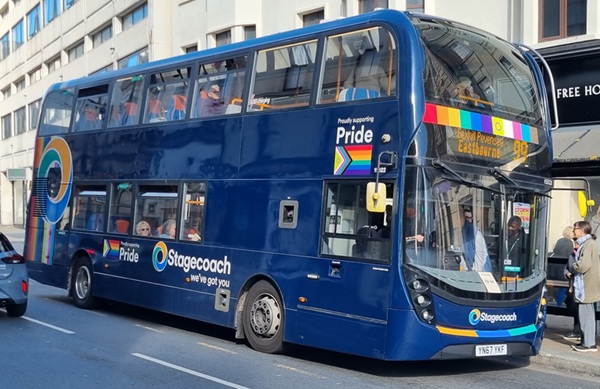

A chronic lack of bus lanes continues to make life difficult for the local bus operator, Stagecoach, and difficult for customers and for life without a car, the company’s Joel Mitchell tells Anna Sabin. Costs have gone up and revenues down, making it harder to achieve the investment required to improve the service. But there have been advances, such as the introduction of real-time information boards at many bus stops, and the replacement of some older vehicles with newer double deckers.
Joel Mitchell and I talked buses the other day. He is managing director of Stagecoach South East operating in East Sussex and Kent and I am a member of Hastings Area Bus Users Group – though I don’t actually use buses very often. I ride a bike, and cycling, walking and bus riding are all up against the same difficulty – which is that cars are so numerous that there’s not enough space to comfortably get around in any other way.
The conversation on improving Hastings’ bus services involves not just Stagecoach and the transport authority, East Sussex County Council, but also MP Helena Dollimore, who has liaised with both parties and convened meetings to enable bus users to give Stagecoach feedback on how they want the service to change.

The conditions in which Stagecoach operates have in some ways become more difficult in recent times. Since Covid, Joel tells me, the cost of running a bus network has gone up between 35% and 40%. But revenue’s gone down because fewer people are riding buses. “Your cost per mile and your revenue per mile, they just crossed over” – he crossed his wrists to illustrate. Funding, he said, imagining it like a pendulum, “starts swinging away from the fare box and towards the tax payer.”
This has led to what he believes to be unhelpful debates about whether the buses should be privately owned, council owned or franchised – all, in Joel’s view, “a distraction from the real question which is – how do you get people out of the car and onto the bus? The model isn’t the issue, it’s who’s going to fund physical infrastructure changes to get bus lanes, bus priority measures, cycle lanes and more people walking so there’s a joined-up strategy?”
Conditions for buses are getting worse. It takes 10 minutes longer for a bus to travel 10 miles today than it did 10 years ago, he tells me. “You can’t just continue to run at a loss because in the end you go bust. It doesn’t really matter who the owner is.”
Political will
To prove his point he told me, “Places like Brighton, Reading, Edinburgh and London are all run in different ways – commercial, council-owned or franchised – but they are all successful because of political will to separate the car from the bus.”
Our Local Transport Authority has not yet segregated any road space in Hastings away from cars for other uses. So what does Joel feel he can do to get them working towards bus lanes? “We’re incredibly fortunate,” he said, “both Kent and East Sussex County Council are really good. They’ve got really good people in their transport teams who really care.”
I’m not sure everyone would agree with this, given Hastings’ uneven, often parked-on pavements, comfortless bus stops, muddy overgrown paths and lack of pedestrian crossings. Some might think our Local Transport Authority doesn’t care at all.
Improvements for buses, bikes and walking are being achieved. But very slowly and always elsewhere – as if the LTA can only do one thing at a time and never in Hastings.
Along Seaside in Eastbourne they have cleared the way for bus lanes, not as completely as they might have due to local objections, but nonetheless the buses that use them could save up to 7 minutes each way – which will make them more frequent, more reliable, hopefully more used and so more profitable.
But why has it taken so many years to achieve, I ask, and why aren’t there more of them? “Because it’s really hard to get the political will across the board and there’s always quite a lot of people anti them,” says Joel. Surely we have to get better at this process, I think.
“Stagecoach in Hastings is in a difficult financial position which makes investment incredibly difficult,” Joel wrote in a follow-up email exchange. “Road closures, congestion and the current franchising feasibility study has made both the operating and investment conditions hugely challenging. “
Newer buses
“Nonetheless, the South East leadership team has worked with other Stagecoach operating companies across the UK where the fleet is being fully electrified in order to send Hastings newer vehicles as part of that cascade.” Thus Hastings has got “15 or 16 double deckers that were at least 9 years newer than the ones they were replacing.”
“And under Mick, our new engineering manager at the Hastings depot, it’s gone from the worst engineering depot in terms of breakdowns and vehicles off the road to the best.
“Another thing – we’re replacing all of our ticket machines finally. The complaint with the old ones was that when a bus lurched over a pothole the SIM card transmitting location popped out and someone who’s been watching it on their app suddenly sees the bus vanish.”
Information boards

Real Time Information Boards, RTIs, owned and run by East Sussex and Kent County Councils, are seen at more and more bus stops and are loved by customers – as long as they’re not delivering false promises and misinformation. When working properly they provide a railway standard of service – you don’t need the flap of an app to find your bus.
“47% of over 70s don’t have smartphones – a significant part of my customer base,” says Joel, “something like 22% of families are in a low income category, meaning they may not have a car and might not have a phone.”
But “local government budgets have reduced over the years,” he says. “We’re utilising a lot of the bus grant money, which is for initiatives to drive future growth, to support current service provision and that is a frustration.”
In Dover, where there is a lot of new housing being built, Homes England have invested nearly £23m on segregated bus lanes between Town and housing developments in Whitfield. That has justified “the first five electric vehicles I’ve got in my operating area. Out of about 400 buses only 1.25% are electric! I need more EVs to get my environmental position to where I want it.

“The Fastrack is working really nicely but the criticality of that scheme isn’t the electric vehicle, it’s the dedicated roadway – because the bus runs to time, because it’s not getting snarled up in congestion.”
How to improve Hastings
I ask him how he’s going to make things better for Hastings? He says:
“Number one, if we do get the fully electrified fleet at Dover, it gives us the opportunity to internally cascade. So I’ve got some great diesel buses at Dover – Euro 6, which are cleaner than the average family car.
“Number two, I’m really excited about the new ticket machines…they will make a significant difference to the reliability of the app and RTIs.
“Number three, East Sussex County Council have got the money to introduce another load of RTI boards.
“Number four, I know there is capital available to do some bus priority stuff in Hastings and we just need to work out with East Sussex where that’s going to be. It would be wonderful to see even a bit of bus lane. It would just psychologically give us all such a lift because it starts to say, right, there’s the political will to do this prioritisation of bus infrastructure here.”
I lament to him that the first traffic-free road for buses will be through the middle of the Town Centre Public Realm and Green Connections project! A bus-only Queens Road would be better for buses. They would have to share only with access-traffic to homes, deliveries and to Morrisons but not with through traffic. Then Harold Place could become spectacular public realm and calm and grace could return to the town centre. It would give the town a new park, a place for tourism and footfall for shops.
“I think that’s fair,” he says, “I don’t think we had that conversation. A bus only road [Queens Road]…wasn’t originally proposed.”
It was proposed, I tell him, but only by the original designers of the project and all the Hastings transport campaign groups. Representatives from Stagecoach and the Transport Authority declined to consider it.
Which is a pity as he now says – “The one thing I’ve learned in 27 years of working in the transport sector is where you treat it as a full system, it thrives and where you don’t it doesn’t. It’s down to the infrastructure owner and the operator to make sure you’re looking at a thing holistically when you’re making decisions.” I long for the day.
Unhelpful moves
Instead of that there are now two developments on the horizon, both in Joel’s view unhelpful – a pause in the Local Government Reorganisation process and a significant amount of money being made available to do a pre-franchising feasibility study in Brighton, East Sussex and West Sussex – causing uncertainty and expensive distraction respectively.
“Stagecoach doesn’t mind what model we’re operating in. We will do our best to run buses, whatever the political choice of operating model…but we need to know what it’s going look like…quickly…” or it stalls Stagecoach investment, he says.
But then he gives me a fifth piece of good bus news for Hastings – investment from the Government. The £2 fare cap is coming back in January. “We lost somewhere between 7 and 10% of commercial passengers when it went from £2 to £3. But, he says, “if fewer come back it may be difficult to get to a level where the operating costs are covered by the revenue.” £3 fare-paying passengers put more into a bus company than £2 fare-payers, even with their taxpayers’ top up. So you need more of them to break even and more still to make a profit.
I interrupt to ask if a bus company can’t put pressure on their Local Transport Authority by saying – “we can carry the £2 fare if we have more road space dedicated to us.”
“Your point is a really good one,” says Joel. “But the timelines don’t add up. The £2 cap is coming in January…but dedicated bus only road space – by the time they’ve gone through the consultations, it’s 2035.” Again I think – surely we have to get better at this process?
Eastbourne, Hastings, Dover, Thanet, Hearne Bay are all retirement-heavy towns where a third of Stagecoach’s passengers ride on the concessionary scheme (pensioners’ free bus passes) – “but that’s set by design to be no net gain to the operator. So if a third of your model is just to break even, you’re going to have the other two thirds working much harder to get you to a margin to cover the cost of capital borrowing to electrify…so the model’s a challenge.”
The bus-wish I hear most frequently from residents and visitors is for a bus running without detour between Glyne Gap and Rock a Nore. Hastings’ seafront is a four lane road with parking taking up a lane either side and underused underground parking beneath. “There are your bus lanes, Joel”, I say. He agrees – “For me they’re prime sites,” he says.
“We did an open top a few years ago and it didn’t come close to covering its operating costs. But, if it could have just turned (at Rock a Nore or at the top of All Saints Street) and stuck to…where people wanted to travel…But we had to go up (London Road to turn) losing 50% of its mileage on places where tourist weren’t wanting to go. But, if the infrastructure was there, we’d certainly look to use it…to drive patronage.”
Hastings – not Canterbury or Portsmouth
Hastings isn’t a university town. It doesn’t have the bus-riding student economy that Canterbury has or the working port city economy and universities that Portsmouth has where bus services and revenue are growing. It’s a tourist town with industry around its northern and western edges. Its biggest employer, the hospital, is three miles from the town centre and there’s lots of new housing three or four miles from sea and services with no extra connectivity provided other than space for new residents to park cars next to electric charging points.
Having every new Hastings household add a car or three to Joel’s congestion problem is digging our hole deeper. “The single biggest contributor for any cancellations to Stagecoach Southeast over the last couple of months has been traffic congestion,” he tells me. Road works and street works make things even worse. Street works are the emergency sort which happen without warning or opportunity to plan or inform customers and he’d like to see them better managed. It is frustrating, he says, that in spite of the service having got much smarter there remain these intransigent outside factors over which Stagecoach has no control.
It looks like to grow that two thirds of fare paying customers and lighten the burden of traffic in our tourist town we need a whole network of bus lanes. Only then will we have a nirvana of fast, frequent, frustration-free transport.
Leave a Reply
You must be logged in to post a comment.